Most traffic accidents are caused by novice drivers. To help combat this problem we developed an eye-tracking software which would check if the driver was looking in the mirror. Many different types of haptic, visual and sound-based feedback was tested. The final concept was a system that would track the eye movements of the users and if they would not look at their mirror correctly, they would be notified by a vibration via a wristband.
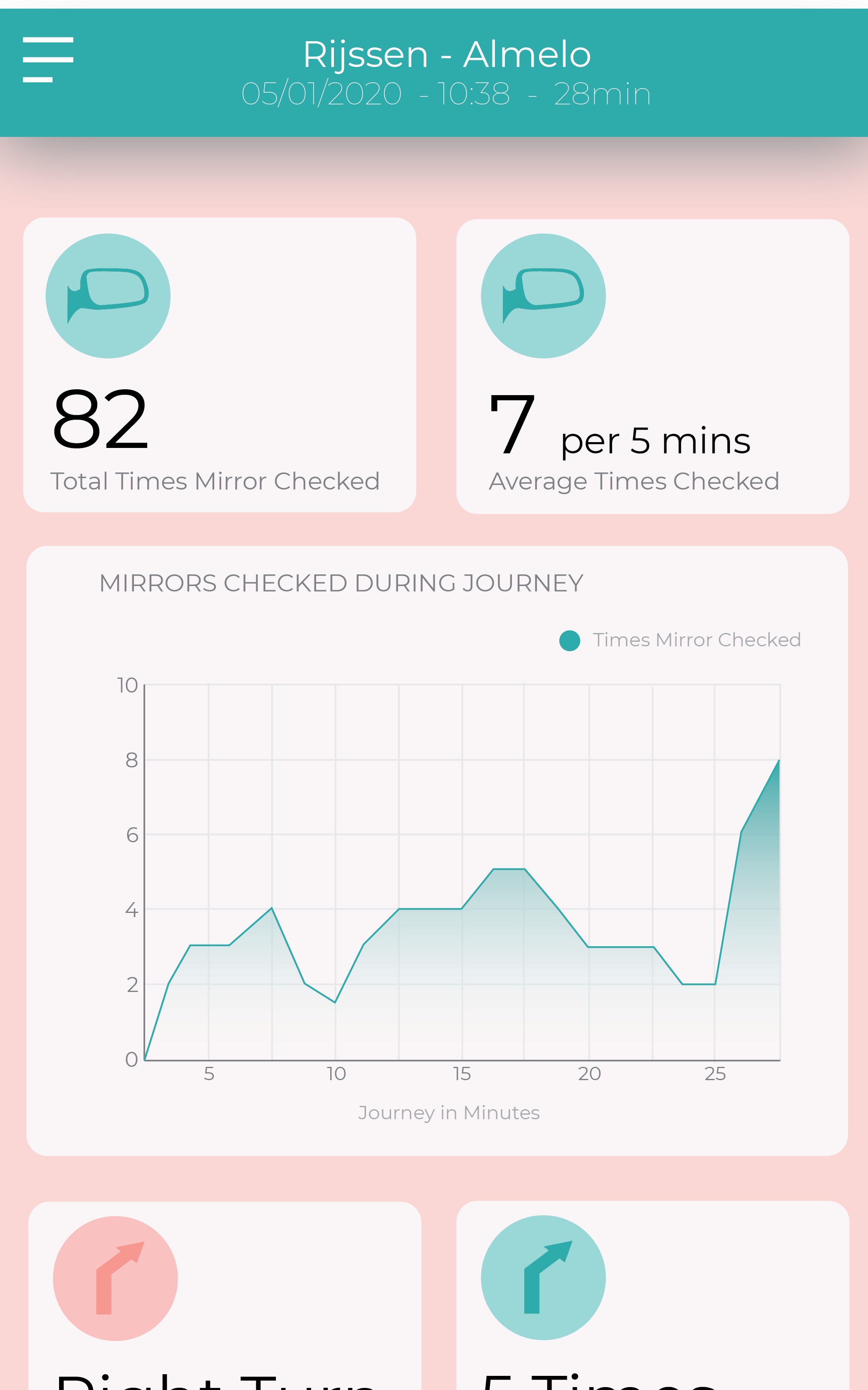
A big percentage of small accidents are caused by people forgetting to check their mirrors before making a turn. By increasing the mirror checking behaviour the aim is to reduce this number. By adding an application to the device through which users can see statistics about their drive and their mistakes in the mirror checking. This can give users more insight into their mistakes and so increase their self-awareness and hopefully result in a safer driving environment for everyone.
The user will have a non-invasive wristband that gives haptic feedback. This is a small interaction with the user and thus makes for minimal distractions whilst still maintaining its goal. After the drive, the user can interact more with the system as it can take a look into statistics about the drive (e.g. how many left-hand turns were made without checking the mirror).
The following global requirement has also been reached as the mobile phone which is used for eye-tracking can be integrated into the already existing obstructions in the driver’s field of view.
The way the user interacts with the system and following the results of the High-fi prototype tests, it can be determined that the device increases the mirror checking behaviour.